

If you’ve ever been told your child has myopia and thought, “Okay… what does that mean?” You’re not the only one!
Myopia, also known as nearsightedness, is when things up close look clear, but look blurry from a distance. This happens when the eye grows too long, causing light to focus in front of the retina instead of directly on it.
Think of it this way: Regular glasses correct the blurry vision so your child can see clearly. Myopia control lenses take it a step further by helping manage how quickly myopia progresses.
It is important to remember that children’s eyes are still growing, which means their prescription can change as they get older. Some children may have very little change, while others can become more nearsighted quickly.
So… How Do Myopia Control Lenses Actually Work?
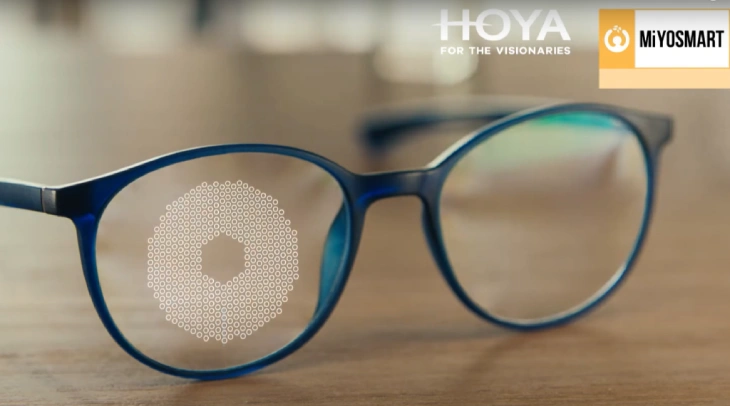
At inFocus Vision Care, we use MiYOSMART lenses by Hoya for myopia management.
MiYOSMART lenses use D.I.M.S. Technology, which stands for Defocus Incorporated Multiple Segments. With this, the centre of the lens provides the prescription your child needs to see clearly and around that area are small sections that create a special type of defocus designed to help slow the growth of the eye.
In simple terms, your child gets the clear vision they need while the lens also helps slow the progression of myopia.
But… Does It Actually Work?
This is probably the question every parent wants answered. The short answer is: research shows that MiYOSMART can slow myopia progression in children. In a two-year clinical trial, children wearing D.I.M.S. lenses had about 60% less myopia progression compared with children wearing regular single-vision lenses.
Although every child is different, myopia control isn’t a promise that your child’s prescription will never change. The goal is to slow down the progression as much as possible while their eyes are still growing.
Why Does Myopia Control Matter?
You might be wondering, “If my child can see perfectly with their glasses, why do we need to worry about it?”
Simple.
Myopia isn’t only about blurry vision. As it becomes more severe, the risk of certain eye conditions later in life can increase including, retinal detachment, glaucoma, cataracts, or myopic maculopathy.
What Can Parents Do?
The first and most important step is to keep up with regular eye exams.
Children don’t always realize that their vision isn’t as clear as it could be. They may assume everyone sees the world the same way they do, so they might not mention that the classroom board looks blurry or that they’re having trouble seeing things.
Regular eye exams allow your optometrist to monitor your child’s vision, check their overall eye health and track changes in their prescription over time. The good news for parents in Ontario is that OHIP covers regular eye exams for children and youth under the age of 19, making it easier to stay on top of their eye health without worrying about the cost of a routine exam.
The Bottom Line
Myopia control isn’t about waiting until your child needs stronger glasses and then trying to catch up. It’s about being proactive and giving their eyes the care they need as they grow.
For more information, concerns or inquiries, or to book your next eye exam, get in touch with inFocus Vision Care. It all begins with you taking care of your eyes!